

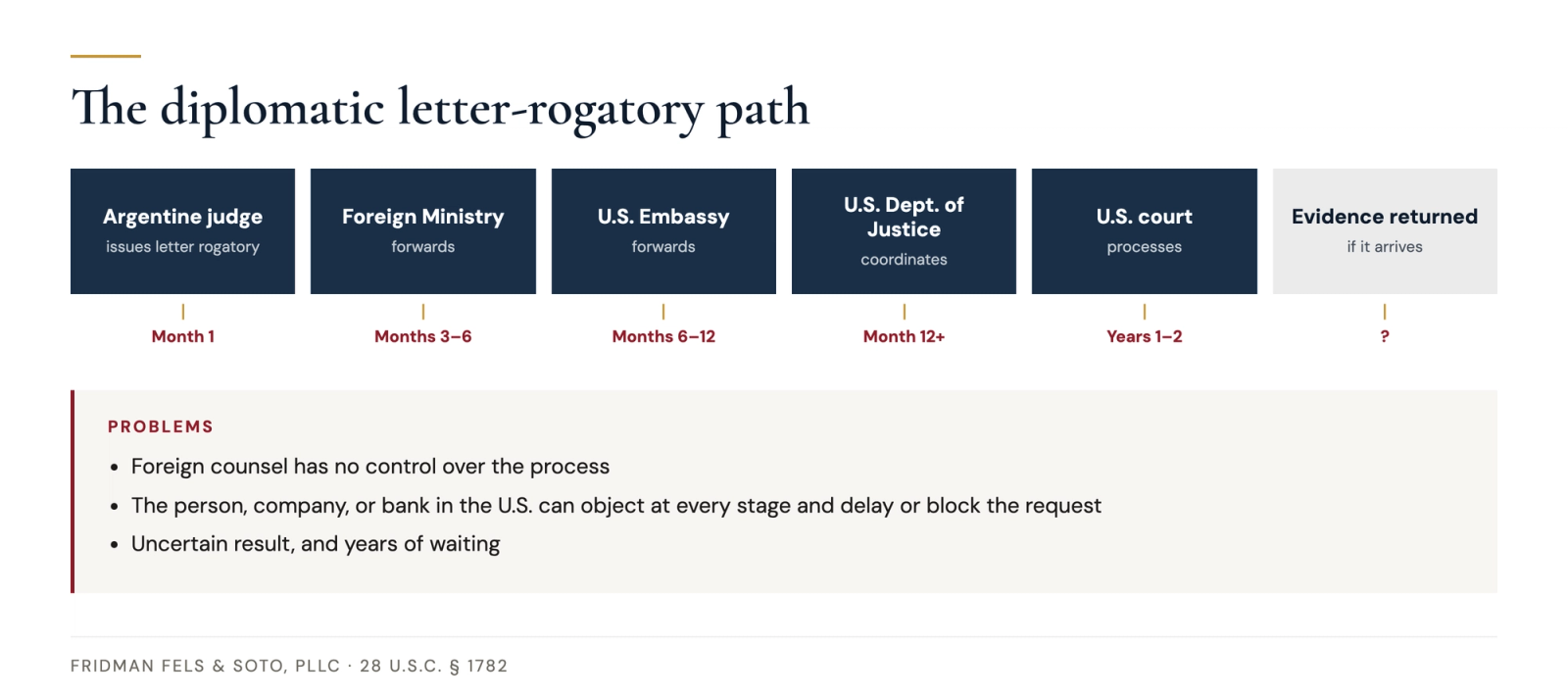
A litigant in Buenos Aires, São Paulo, or Mexico City who needs documents from a bank in the United States has traditionally used a letter rogatory under the Hague Evidence Convention. The request travels through the foreign ministry, the embassy in Washington, the U.S. Department of Justice, and finally a federal court that knows nothing about the case. A year is routine. Two is common. At every stage, whoever holds the evidence can object, lawyer up, and wait.
Meanwhile the money moves, the structures reorganize, and the procedural window in the foreign case closes.
Federal law offers a faster path, with no letters rogatory and no embassies. Our firm's recent applications under it have produced court orders in nine days and, most recently, in forty-eight hours.
The statute
Under 28 U.S.C. § 1782, a federal district court may order any person or company found in its district, including a bank, to produce documents or give testimony “for use in a proceeding in a foreign or international tribunal, including criminal investigations conducted before formal accusation.”
Three features give the statute its reach for Latin American counsel:
- Any “interested person” may apply. A party, a private complainant, a creditor in an insolvency, or someone preparing to sue can petition directly through U.S. counsel. The foreign judge need not be involved.
- The application goes straight to the federal court where the evidence sits. No diplomatic channel touches it.
- The foreign proceeding need not exist yet. The Supreme Court held in Intel Corp. v. Advanced Micro Devices, Inc., 542 U.S. 241 (2004), that proceedings “within reasonable contemplation” qualify, and the Eleventh Circuit applied that rule in Consorcio Ecuatoriano de Telecomunicaciones S.A. v. JAS Forwarding (USA), Inc., 747 F.3d 1262 (11th Cir. 2014), where an Ecuadorian telecom obtained discovery in Florida for suits it had not yet filed in Ecuador.
One more point surprises many Latin American lawyers. The United States recognizes no bank secrecy that withstands a federal court order. Once the order issues, the bank must comply.
What you can obtain
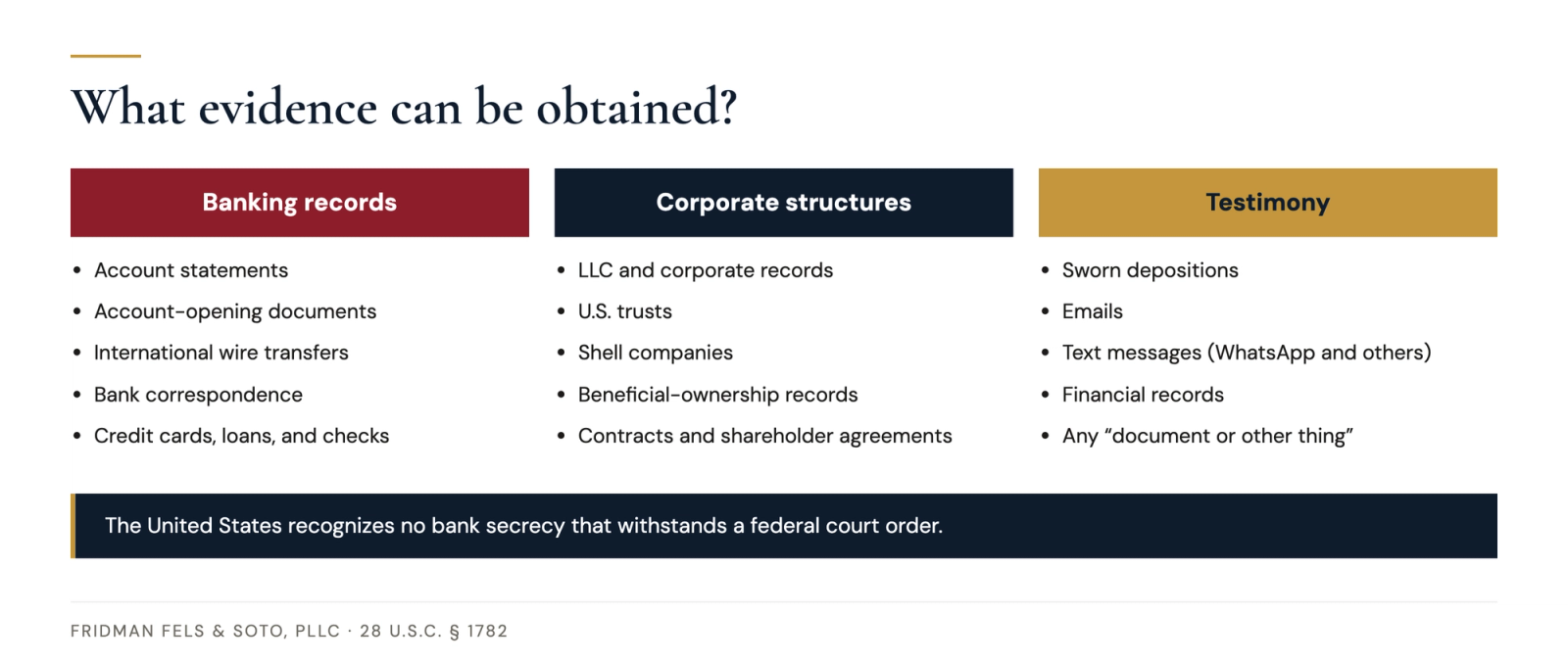
The statute reaches nearly any documentary or testimonial evidence located in the United States. That includes account statements, account-opening files, wire transfer records, and bank communications; the formation and beneficial-ownership records of LLCs, corporations, and trusts, shell companies included; and depositions of the people who managed the accounts, along with emails, text messages, and financial records.
The practical limit is discipline rather than scope. Overbroad subpoenas get narrowed or denied, so every request must map to what the foreign case actually needs.
The requirements
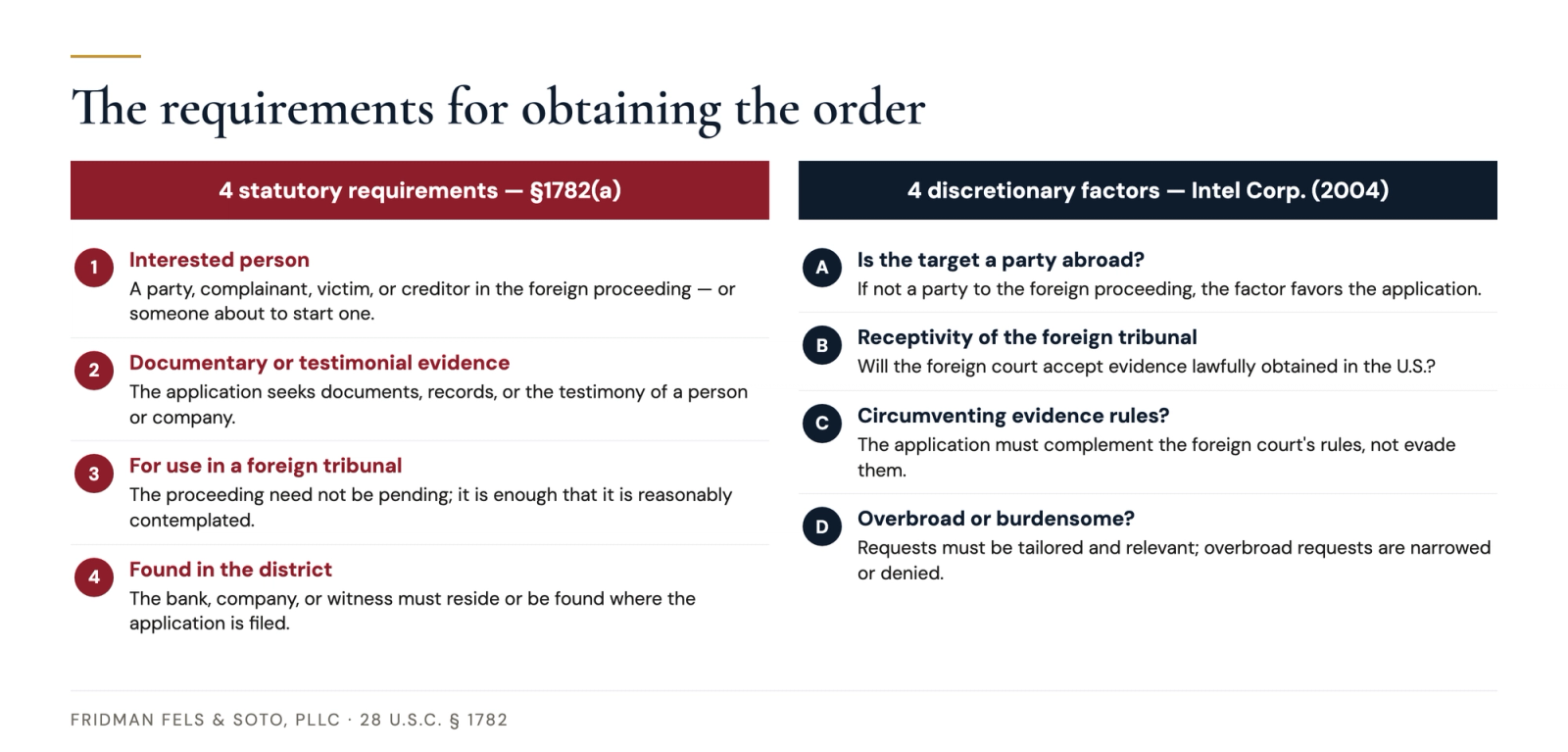
The Eleventh Circuit, whose law governs applications filed in Miami, set out the framework in In re Clerici, 481 F.3d 1324 (11th Cir. 2007). Four statutory requirements are mandatory. The applicant must be an interested person in the foreign proceeding, the petition must seek documents or testimony, the evidence must be for use before a foreign tribunal, and the person holding it must reside or be found in the district where the petition is filed.
The court then weighs Intel's four discretionary factors. It asks whether the discovery target is a party to the foreign proceeding, whether the foreign tribunal will be receptive to the evidence, whether the petition attempts to circumvent foreign restrictions on proof, and whether the request is unduly intrusive or burdensome. No single factor controls. When all four favor the applicant, orders issue quickly.
Where petitions fail
Adversaries resist on predictable grounds, and anticipating them is most of the work.
Is there a “proceeding” before a “tribunal”? An investigation run solely by a prosecutor, with no judicial involvement, may not qualify. Proceedings a judge controls do. Courts also police the line between a contemplated proceeding and a hypothetical one; in Department of Caldas v. Diageo PLC, 925 F.3d 1218 (11th Cir. 2019), the applicants spent years litigating whether their planned Colombian suits were within reasonable contemplation. The cure is documentary. File the case number, the docket, and the foreign court's rulings with the petition.
Is the evidence truly “for use” in the proceeding? The applicant must be able to inject it into the foreign case. Handing documents to a prosecutor and hoping is not enough. A complainant with party status or a creditor in an insolvency typically qualifies, while a mere witness generally does not. What the U.S. court will not do is decide the foreign case itself. The Eleventh Circuit held in Furstenberg Finance SAS v. Litai Assets LLC, 877 F.3d 1031 (11th Cir. 2017), that challenges to the applicant's standing in the foreign proceeding belong to the foreign tribunal, not the §1782 court, so adversaries who litigate the foreign merits in Miami are fighting in the wrong forum.
Is it filed in the right district? The petition belongs where the documents or witnesses are found, and evidence spread across states means parallel petitions in several districts. Corporate formalities can help, because banks incorporated in the same state can sometimes be reached through a single court there.
Who is the “interested person”? The client, not the lawyer. Foreign counsel advises and supports the petition, and the client holds the legal interest.
Mexico: concursos, interventores, and criminal courts
Mexican proceedings deserve their own word, because they supply some of the clearest §1782 paths in the region. A concurso mercantil is a judicial insolvency proceeding, and it qualifies. Better still, Mexican insolvency law builds in the injection mechanism the statute requires. Creditors holding more than ten percent of recognized claims are represented by a court-appointed interventor with the duty to pursue recovery of estate assets, and the receiver holds parallel powers, so §1782 evidence tracing diverted funds has an officer of the concurso ready to present it.
Mexican criminal practice qualifies as well. Control judges (jueces de control) who issue arrest warrants and seizure orders, the district courts that hear amparo challenges, the collegiate courts above them, and the Supreme Court of Mexico are all tribunals for §1782 purposes, and a victim with party status in those proceedings can seek U.S. discovery to support them.
One structural point favors private parties. Government-to-government evidence channels such as MLAT treaties are unavailable to private litigants, which makes §1782 the only meaningful route for a Mexican creditor, victim, or trustee to reach evidence held in the United States.
How it works in practice
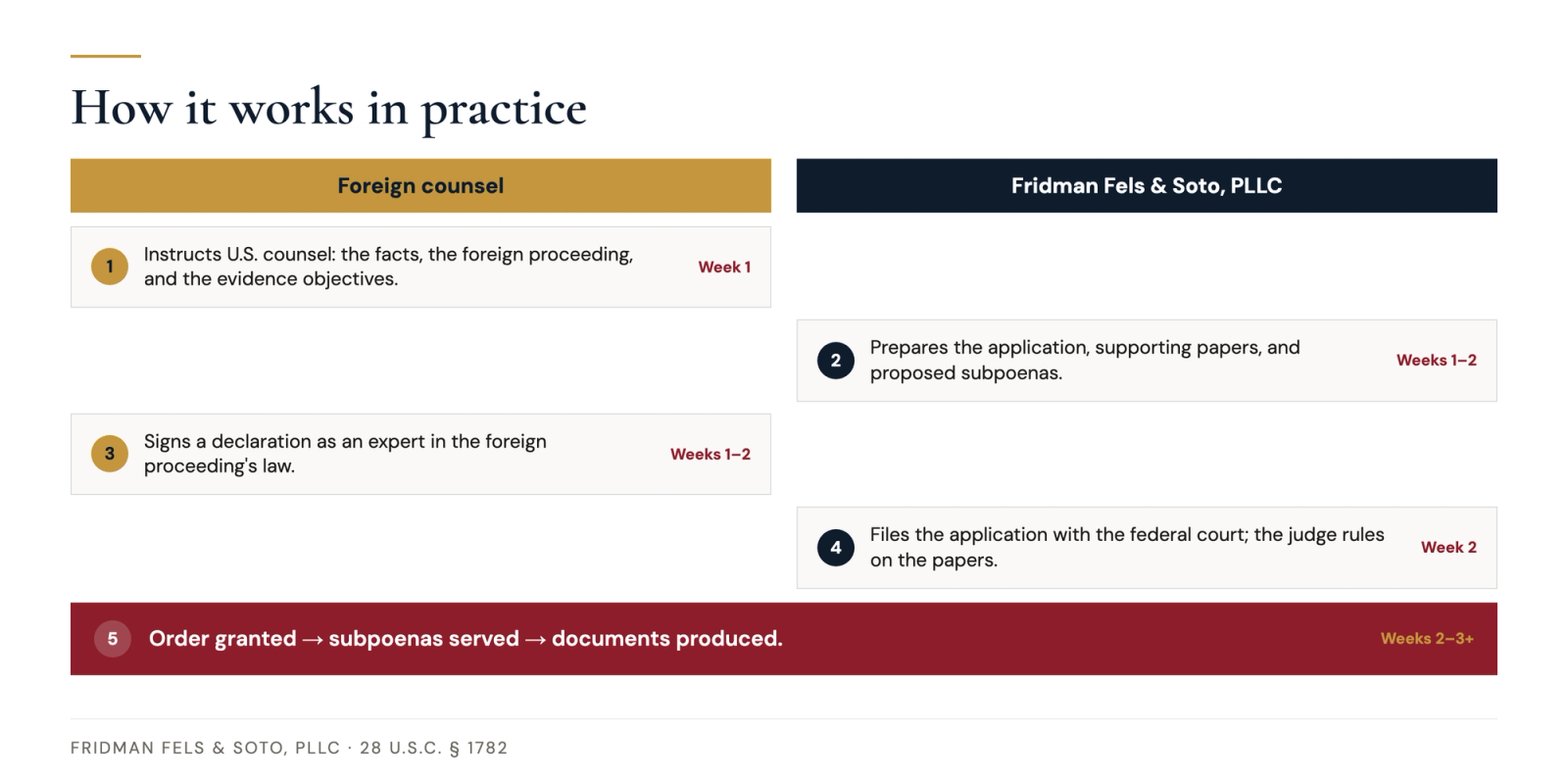
- Foreign counsel instructs U.S. counsel on the facts, the state of the foreign docket, and precisely what evidence the case needs.
- U.S. counsel prepares the ex parte application and drafts subpoenas identifying the specific records sought.
- Foreign counsel signs a sworn expert declaration on the law of their country. This is the most important document in the application, because it is the federal judge's only window into the foreign proceeding. It must establish the declarant's credentials, describe the foreign case, explain why the evidence matters, confirm the foreign court will accept it, and attach the underlying record with certified English translations.
- U.S. counsel files the application. Many districts consider an initial §1782 application on the papers, because the order does no more than authorize subpoenas. Practice varies by court, and part of U.S. counsel's job is calibrating the application to the forum's expectations.
- The order issues, subpoenas go out, and the bank produces.
The procedure is not one-sided. An order under §1782 only authorizes the subpoenas, and the recipient keeps every objection it has, including scope, burden, privilege, and jurisdiction, before producing a single document. A complete application moves quickly because the judge has everything needed to rule, and the respondent loses nothing by the timing. That balance is what separates §1782 from the letter rogatory, which offers neither speed to the applicant nor any real process to anyone.
Two recent matters
Nine days. In 2025, our firm filed a §1782 application in the Southern District of Florida for six Argentine citizens, victims of a multimillion-dollar real estate fraud, seeking the Miami banking records of the defendant and more than twenty related companies at Wells Fargo and Citibank. The evidence supported one criminal, two civil, and one insolvency proceeding pending in Argentina. Filed May 19, 2025. Granted on May 28, with all four statutory requirements and all four Intel factors satisfied.
Forty-eight hours. In a more recent application arising from a Mexican insolvency proceeding, the court granted our client's §1782 application within forty-eight hours of filing. Speed at that level is not luck. It reflects a petition the judge could grant on the papers, with the expert declaration, the foreign record, and narrowly drawn subpoenas all in place on day one.
What this means for Latin American counsel
For any dispute that touches the United States, whether through bank accounts in Miami, an LLC in Florida, a trust in Delaware, or wire transfers through New York, §1782 turns the country from a black box into the most productive evidence jurisdiction available to a Latin American litigant. The outcome is decided before filing. The foreign proceeding must qualify, the expert declaration must carry its annexes and certified translations, and the subpoenas must be drawn so that no Intel factor cuts against the petition.
Fridman Fels & Soto regularly serves as U.S. counsel for §1782 applications arising from proceedings across Latin America, working with counsel in Argentina, Brazil, Mexico, and elsewhere in the region, in English, Spanish, and Portuguese. Two of the firm's matters are summarized in more depth on this site: tracing diverted bond proceeds across three continents under §1782 and a civil RICO recovery for Argentine real estate investors. Daniel Fridman leads the practice.
This article is adapted from a seminar on §1782 discovery and asset tracing presented by the firm in Buenos Aires in April 2026, together with Tavarone Rovelli Salim Miani.
Learn more about our Section 1782 discovery practice.
Frequently Asked Questions
What types of foreign proceedings qualify for §1782 discovery?
Proceedings before a foreign court or other body exercising governmental authority qualify. That includes civil litigation, criminal proceedings under a judge's control (including criminal investigations conducted before formal accusation), and insolvency proceedings such as a Mexican concurso mercantil or an Argentine concurso. The proceeding need not be pending. Under Intel Corp. v. Advanced Micro Devices, Inc., 542 U.S. 241 (2004), it is enough that the proceeding is within reasonable contemplation, though it must be more than an idea in counsel's mind. See In re Clerici, 481 F.3d 1324 (11th Cir. 2007); Consorcio Ecuatoriano de Telecomunicaciones S.A. v. JAS Forwarding (USA), Inc., 747 F.3d 1262 (11th Cir. 2014). Private commercial arbitration does not qualify.
Can §1782 be used for international arbitration?
No. In ZF Automotive US, Inc. v. Luxshare, Ltd., 596 U.S. 619 (2022), the Supreme Court held that only a tribunal exercising governmental or intergovernmental authority is a 'foreign or international tribunal' under the statute. Panels in private commercial arbitrations (ICC, ICDR, LCIA, and similar) do not qualify, and in the companion case the Court held an ad hoc investor-state panel did not qualify either. What remains available is discovery for use in the court proceedings that surround an arbitration, such as annulment or enforcement litigation, and in related civil, criminal, or insolvency cases.
Do Mexican concursos mercantiles and other Latin American insolvency proceedings qualify?
Yes. A concurso mercantil is a judicial proceeding, and creditors, trustees, and other interested parties routinely use §1782 to obtain U.S. evidence for it, such as bank records tracing pre-petition transfers or documents supporting a fraudulent-transfer challenge. In a recent application our firm filed for an indenture trustee in connection with a Mexican concurso, the court granted the §1782 order within forty-eight hours of filing.
What does 'for use' in a foreign proceeding actually require?
The applicant must be in a position to inject the evidence into the foreign proceeding. A party, a private complainant with party status (querellante), or a creditor in an insolvency typically qualifies. Handing documents to a prosecutor and hoping the prosecutor uses them is not enough, and a mere witness generally cannot satisfy the requirement. The evidence may also serve more than one purpose; using it in the foreign case does not become improper because it could matter elsewhere, so long as the application is made in good faith rather than to circumvent discovery limits. The Eleventh Circuit has also held that challenges to the applicant's standing in the foreign proceeding are for the foreign tribunal to decide, not the §1782 court. Furstenberg Finance SAS v. Litai Assets LLC, 877 F.3d 1031 (11th Cir. 2017).
Who qualifies as an 'interested person'?
The client, not the lawyer. Parties to the foreign proceeding always qualify. So do private complainants, victims with party status, creditors in insolvency proceedings, and someone who is preparing to file a proceeding that is reasonably contemplated. Foreign counsel supports the application, most importantly through a sworn expert declaration on the foreign proceeding, but the client holds the legal interest.
How fast can a §1782 order be obtained?
A complete, well-supported application can be granted quickly because the court has everything it needs to rule on the papers. Our firm's recent applications in the Southern District of Florida produced orders in nine days and, most recently, in forty-eight hours. The order itself only authorizes subpoenas. The recipient keeps every objection, including scope, privilege, and jurisdiction, and can move to quash before producing anything, so the speed of the initial order takes nothing away from the target's rights. Practice varies by district, and the application should be calibrated to the forum.
Does U.S. bank secrecy protect account records from §1782 discovery?
No. The United States recognizes no bank secrecy that withstands a federal court order. Once the court authorizes the subpoena, the bank must produce the records, including account statements, account-opening files, wire transfer records, and communications.
Can §1782 discovery be used against a law firm?
Yes. A law firm found in a U.S. district is subject to §1782 discovery like any other person or entity. The Oro Negro Drilling petition, in which our firm sought discovery from opposing counsel based on allegations that the firm received $8 million traceable to client funds, is an example. Privilege and work-product objections are typically raised in defense, and their strength depends on the specific documents.
Where must the application be filed?
In the federal district where the person or company holding the evidence resides or is found. Evidence spread across several states means parallel applications in several districts, though corporate formalities sometimes help, because banks incorporated in the same state can be reached through a single court there. Choosing the districts and sequencing the applications is part of the strategy.


